
Office Address
18/09, Block B, Bosila City R/A
Mohammadpur, Dhaka - 1207
Phone Number
+880 9638 667701
+880 1711 871722
18/09, Block B, Bosila City R/A
Mohammadpur, Dhaka - 1207
+880 9638 667701
+880 1711 871722


 by Naeem Patoary
Traditional Bengali foods are deeply connected to our childhood memories, family traditions, and cultural heritage. From mango pickles and amsotto (mango fruit leather) to date palm jaggery, sesame sweets, and traditional son papdi, these foods represent more than familiar flavors. They reflect generations of culinary traditions and cherished experiences.
As technology continues to reshape consumer behavior, the way people discover and purchase traditional foods is also evolving. Today, customers increasingly prefer exploring products, comparing prices, and placing orders online without visiting physical stores.
This shift has created new opportunities for traditional food businesses to reach customers through digital platforms.
MamaBari is a Bangladeshi traditional food brand dedicated to bringing authentic local flavors to customers. Based in Chapainawabganj, the brand offers a diverse selection of traditional products, including mangoes, mango-based delicacies, pickles, jaggery, sesame sweets, son papdi, murali, and other popular Bengali treats.
To establish a stronger digital presence for MamaBari, we developed a comprehensive e-commerce website that combines the brand's traditional identity with modern online shopping functionality.
Our objective was to create more than a digital storefront. We wanted to build an online platform where customers could conveniently discover traditional Bengali foods, explore detailed product information, and enjoy a smooth shopping experience.
Before beginning the development process, we focused on understanding MamaBari's business model, product diversity, and customer expectations.
Unlike conventional e-commerce businesses, traditional food brands have unique requirements. Customers often consider product authenticity, packaging size, pricing, ingredients, and product variations before making a purchase.
Furthermore, offering multiple package sizes, seasonal products, and combination deals requires a carefully organized product presentation system.
With these considerations in mind, we established two primary development priorities.
First, the website needed to communicate MamaBari's brand identity while presenting its traditional food collection in an engaging and organized manner.
Second, customers needed a straightforward way to explore products, review relevant details, and proceed with their purchases.
These priorities guided our decisions regarding website structure, user interface design, product categorization, and essential e-commerce functionality.
One of MamaBari's most distinctive characteristics is the emotional connection associated with its name.
In Bengali culture, MamaBari, meaning one's maternal uncle's home, often brings back memories of family gatherings, warm hospitality, and homemade delicacies.
We wanted the website to reflect this sense of familiarity while maintaining the functionality expected from a modern e-commerce platform.
Rather than focusing exclusively on product listings, we developed a website structure that highlights the brand's story, signature products, and special collections.
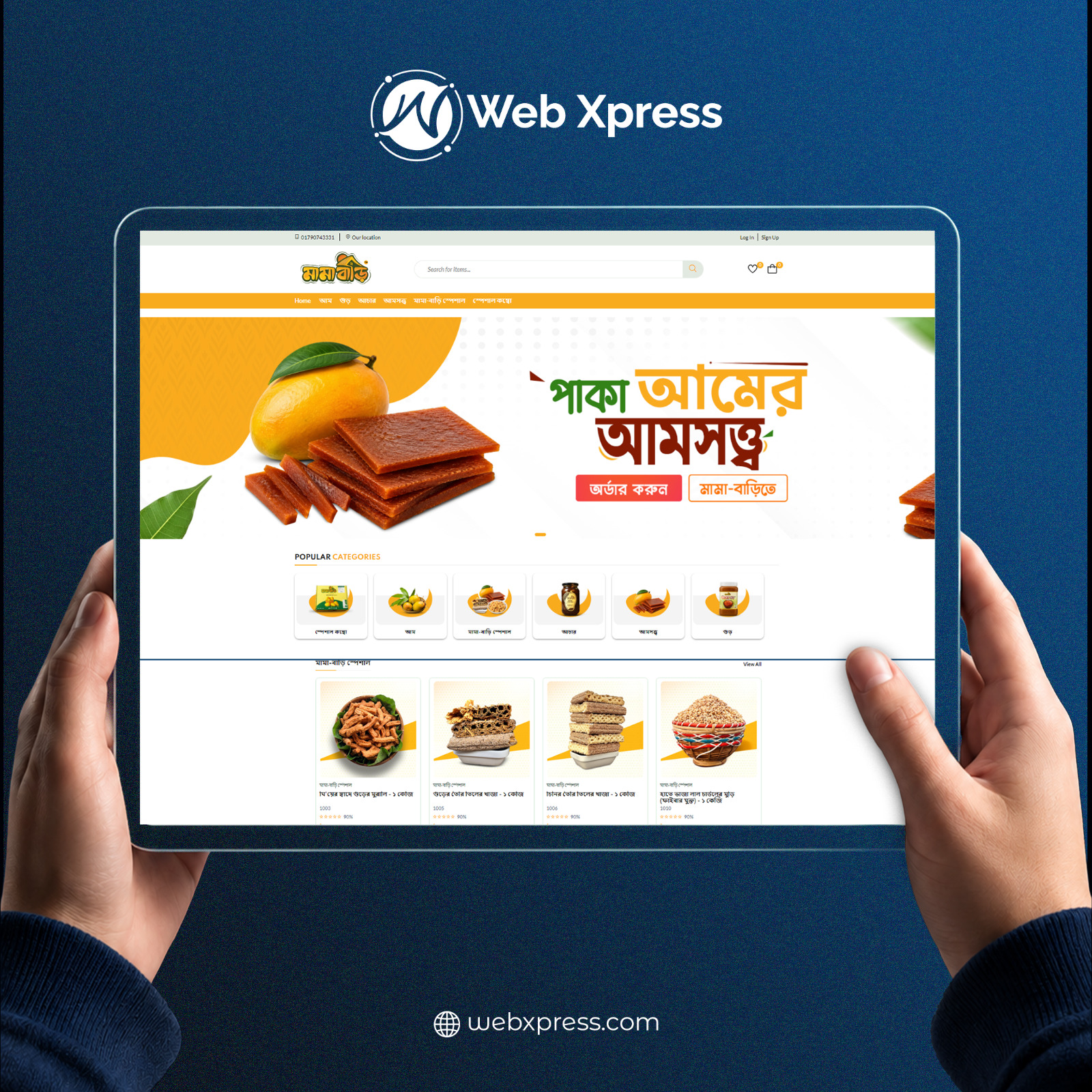
The homepage introduces visitors to MamaBari through brand messaging, featured product categories, and selected traditional food collections.
This approach allows first-time visitors to understand the brand's offerings while creating a digital space that supports both brand awareness and online sales.
MamaBari offers products with different characteristics and purchasing requirements.
Some products are seasonal, others are suitable for regular consumption, and several are available as specially curated combination packages.
Presenting this variety through a single, unstructured product listing could make it difficult for customers to find what they need.
To address this challenge, we organized the product catalog into clearly defined categories.
The website includes sections for mangoes, jaggery, pickles, amsotto, MamaBari Specials, and Special Combos.
Signature products such as jaggery-based murali, sesame sweets, ghee-fried son papdi, and traditionally prepared puffed rice are also presented within relevant collections.
This category-based approach helps customers navigate the product catalog according to their preferences.
It also creates a structured foundation for adding new products and expanding existing collections as the business grows.
Product quantity and package details are particularly important in food-related e-commerce.
Customers may want to purchase the same product in different quantities or select a combination package containing several traditional treats.
MamaBari offers multiple products that require this type of presentation.
For example, the website features different package sizes of jaggery-based murali, assorted sesame sweet collections, and special combinations of sesame sweets and son papdi.
We structured the product presentation to make names, quantities, and prices easy to understand.
Where applicable, regular prices and discounted prices are displayed to help customers identify available offers.
This approach supports informed purchasing decisions and allows customers to select products based on their preferences and budgets.
Our development approach focused on bringing together the essential features required for a convenient shopping experience and an organized online business.
The following functionalities form the foundation of MamaBari's e-commerce website.
We designed the homepage to give visitors a clear introduction to MamaBari's product offerings.
Featured categories, special combinations, MamaBari Specials, pickles, and selected traditional products are displayed in dedicated sections.
Product names, prices, and add-to-cart options are presented to help customers quickly explore available items.
The result is a homepage that combines brand presentation with practical shopping functionality.
Customers approach online shopping in different ways.
Some search directly for a particular food item, while others prefer browsing categories to discover available products.
To accommodate these preferences, we incorporated a product search function into the website.
Product listing pages also provide filtering and sorting options based on criteria such as price and stock availability.
These features allow customers to narrow down the product catalog and explore items that match their interests.
Every product is presented through an individual detail page containing relevant information.
Depending on the product, these pages display images, names, prices, categories, product identification numbers, and stock availability.
Customers can also access available quantity options and purchasing controls.
By presenting this information in a dedicated space, we made it easier for shoppers to review product details before proceeding with an order.
A reliable shopping process is an essential component of any e-commerce platform.
For MamaBari, we implemented a shopping cart system that allows customers to add products, review selected items, and proceed toward checkout.
The cart structure includes product totals, applicable discounts, and the overall payable amount.
Our focus was to create a straightforward purchasing journey that connects product selection with the ordering process.
To support registered customers, we incorporated account registration and login functionality.
New users can create an account by providing the required information, while existing customers can access their accounts using their registered credentials.
The website also includes a password recovery option through a registered phone number.
These features provide a structured system for managing customer account access.
Combination packages are an important part of MamaBari's product offerings.
Unlike individual products, combo packages require a clear presentation of the included items, quantities, and total price.
We created a dedicated Special Combo category to showcase these collections.
Where applicable, promotional and discounted prices are also displayed.
This feature gives MamaBari a practical way to highlight selected product combinations and seasonal promotional offerings.
For a traditional food business, meaningful customer engagement extends beyond displaying products.
Sharing food-related knowledge, product information, and brand stories can help customers develop a stronger understanding of a business and its offerings.
With this in mind, we incorporated a blog section into MamaBari's website.
The section provides a space for publishing content about mangoes, traditional Bengali foods, new products, and the brand's journey.
It also supports opportunities for organic search visibility through relevant, informative content.
As a result, the website serves not only as an online store but also as a platform for communicating MamaBari's brand identity.
Mobile accessibility plays an important role in modern e-commerce.
Customers expect to browse products, navigate categories, and interact with shopping features comfortably across different devices.
We therefore prioritized responsive design throughout MamaBari's website development.
The interface was designed to adapt to different screen sizes, including smartphones, tablets, and desktop computers.
Particular attention was given to product visibility, navigation, content readability, and access to essential purchasing controls.
Our goal was to provide a consistent and convenient shopping experience regardless of the device customers use.
Our involvement in the MamaBari project extended beyond the website's visual design.
An effective e-commerce platform requires different product-related and purchasing functions to work together within a structured system.
Information such as product categories, pricing, package quantities, stock status, promotional offers, and order calculations must be presented consistently.
We considered these operational requirements while planning and implementing the website's underlying e-commerce structure.
Special attention was given to organizing product information, maintaining clear category relationships, and connecting the essential stages of the customer purchasing journey.
By integrating these elements, we established a practical digital foundation for MamaBari's online business activities.
Understanding how customers interact with an online store was a central part of our development process.
Consider a customer looking to purchase traditional mango pickle.
After visiting MamaBari's website, the customer can navigate directly to the Pickles category and explore available products.
Upon selecting a preferred item, they can open its detail page to review the available product information, pricing, and package options.
They can then add the product to their shopping cart and proceed to the next stage of the ordering process.
Similarly, a customer interested in purchasing sesame sweets and son papdi together can explore the Special Combo category and select an appropriate package.
By considering these everyday shopping scenarios, we structured the website to make product discovery and purchasing more intuitive.
The development of MamaBari's e-commerce website has provided the brand with a dedicated online platform for presenting its products and connecting with customers.
Instead of relying exclusively on external sales channels, the business now has its own digital storefront where product collections, promotional offers, and brand information can be displayed together.
The platform creates several important business opportunities.
An Independent Digital Brand Presence: MamaBari can communicate its identity, showcase traditional products, and share its story through a dedicated website.
A Direct Online Shopping Channel: Customers can explore products and move through the ordering process directly from the brand's digital storefront.
Flexible Product Promotion: New arrivals, seasonal products, special combinations, and promotional collections can be featured within relevant website sections.
A Foundation for Business Expansion: The website's structured product catalog provides room for additional products, categories, and future promotional initiatives.
Together, these capabilities support a more organized digital sales presence while creating opportunities for further business development.
The MamaBari project gave us the opportunity to develop a digital solution tailored specifically to a traditional Bangladeshi food business.
One of the most important considerations was preserving the brand's cultural identity while introducing the convenience of modern e-commerce.
We recognize that different businesses require different approaches to website development.
The customer expectations, product presentation requirements, and purchasing behavior associated with a technology store, fashion brand, or traditional food business are not necessarily the same.
For MamaBari, we therefore concentrated on its product characteristics, packaging variations, cultural significance, and customers' practical shopping needs.
This business-focused approach helped us develop an e-commerce platform that aligns with the brand's distinctive identity and online selling requirements.
Traditional Bengali foods carry cultural significance that extends far beyond their ingredients and flavors.
Digital technology creates opportunities to make these familiar products more accessible while helping traditional businesses establish their presence in a changing marketplace.
Through the MamaBari e-commerce website development project, we worked to bring these opportunities together.
By combining a brand-focused design, organized product categories, detailed product pages, special combo collections, customer account features, shopping cart functionality, and a dedicated blog section, we developed a comprehensive platform for the brand's online operations.
What makes the MamaBari project meaningful to us is the opportunity to connect the warmth and heritage of traditional Bengali food with the accessibility and convenience of modern e-commerce.
For our team, this project represents more than building an online store. It reflects our approach to understanding a business's unique identity and translating its requirements into a practical digital solution.
The outcome of that approach is the MamaBari E-commerce Website—a modern digital platform designed to support the online journey of a traditional Bangladeshi food brand.