
Office Address
18/09, Block B, Bosila City R/A
Mohammadpur, Dhaka - 1207
Phone Number
+880 9638 667701
+880 1711 871722
18/09, Block B, Bosila City R/A
Mohammadpur, Dhaka - 1207
+880 9638 667701
+880 1711 871722


 by Naeem Patoary
Choosing a stove for everyday cooking at home is different from selecting one for a restaurant kitchen. The intended setting, cooking volume, stove size, and required accessories all influence the purchasing decision. Selling these products online therefore requires more than displaying images and prices. Customers also need the information and tools to assess whether a product suits their needs.
Nirapod Chula offers a range of wood-burning stoves for residential and commercial use. Its collection includes single- and double-burner models for households, larger commercial stoves in different sizes, and essential accessories.
Our team was responsible for designing and developing the website. The objective was to translate the business’s requirements into an online platform that brings together product information, shopping features, and customer communication. Pasted text
At the heart of our solution was a straightforward goal: help customers move from discovering a product to understanding it, assessing its suitability, and taking the next step toward purchasing.
An important part of planning this project was understanding how different customers make purchasing decisions.
For someone buying a stove for household use, size, the number of burners, and suitability for everyday cooking may be the main considerations. A business customer, on the other hand, may need more detailed information about larger models, specific dimensions, and delivery arrangements.
Customers also arrive at a website at different stages of their decision-making process. Some already know which model they want. Others are exploring alternatives, while some need to discuss a particular requirement before placing an order.
With these differences in mind, our goal was to give customers appropriate ways to move forward. This approach shaped the product organization, detailed information, purchasing options, and communication features throughout the website.
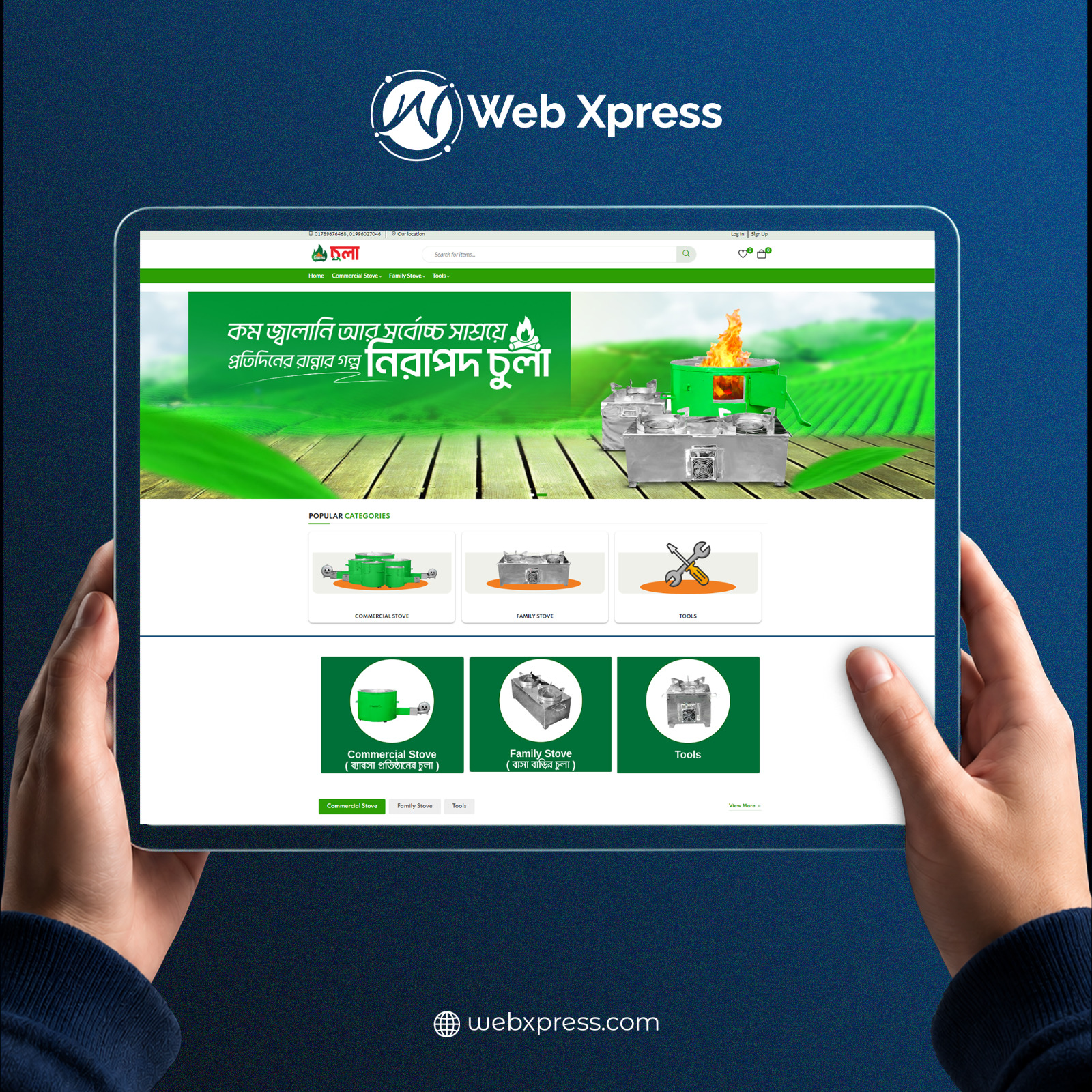
To make the product range easier to understand, we organized the website around three main categories: Commercial Stove, Family Stove, and Tools. This creates a clear distinction between commercial stoves, household models, and supporting accessories.
Within the Family Stove category, single-burner, double-burner, and double-fan double-burner models are presented separately. The Commercial Stove category includes subcategories for round stoves of different sizes, allowing customers to explore options according to their requirements.
Accessories such as adapters, chargers, and multiplugs are grouped under Tools. Separating these items from the main stove collection gives customers a direct route to the relevant products.
The homepage also presents products by category, displays prices, and provides access to the complete collection within each section. Customers can therefore get an overview of the range before moving into a specific category.
Even after entering the right category, not every product will match a customer’s budget or requirements. To support this stage of product selection, the product listings include filtering controls based on price range and stock availability.
Customers also have options for sorting the list and selecting how many products to display. These controls help them narrow the selection to products that are relevant to their needs.
Our focus here was to support initial decision-making before customers open individual product pages.
When buying a stove online, customers cannot inspect the product in person. The information included on each product page—and how that information is presented—therefore plays an important role.
Nirapod Chula’s product pages include multiple images, model names, prices, product identification codes, and stock status. The descriptions also provide information about intended uses, fuel types, fan operation, and construction materials.
Images and written descriptions serve different purposes. Images help customers understand the product’s appearance and structure, while the descriptions provide a basis for assessing its suitability for their intended use.
When organizing these pages, we focused on balancing essential information with more detailed explanations. Customers can quickly check a model and its price, then read further when they need additional information before deciding.
For us, an informative product page is not simply a page with more text. It is one that presents relevant answers to customers’ questions in the right places.
Once customers have reviewed a product, the next step should be easy to identify. For this reason, the product pages include Add To Cart and Buy Now buttons.
One option allows customers to add products to their cart, while the other provides a direct route toward purchasing a specific item. The cart summary is also structured to display product prices, discounts, and the payable amount.
The purpose of this section is to connect product browsing with the next stage of shopping. Customers should not have to search for a way to proceed after making a decision, and they should have an opportunity to review the relevant costs before moving forward.
For products such as stoves, transportation and delivery arrangements are important parts of the purchasing decision. Knowing the product price alone does not answer every question a customer may have.
Nirapod Chula’s product descriptions explain home delivery, collection from courier offices, applicable charges, and order confirmation requirements. They also state the arrangement for paying delivery charges in advance and paying the stove’s price upon receiving the product.
Including these details within the shopping experience gives customers an opportunity to understand delivery and payment conditions before ordering. It also helps keep the website’s purchasing process aligned with the business’s actual sales practices.
Not every component of a product is necessarily covered by the same warranty or guarantee. To explain these differences, the product pages present separate service conditions for components such as the main body, fan, adapter, and burner.
We treated after-sales information as part of the purchasing decision rather than something customers should only discover afterward. Understanding which parts are covered and what support applies helps customers establish clearer expectations before buying.
The website includes a registration form with fields for the customer’s name, phone number, and password. The sign-in interface provides fields for a phone number or email address and a password.
The password recovery interface also includes steps for verifying a registered phone number, entering a six-digit OTP, and setting a new password.
This section addresses more than the needs of first-time customers. It also provides a defined path for existing users who need to regain access to their accounts. Considering these potential difficulties is an important part of user-centered design.
Not every customer’s needs can be met by the products already listed on the website. Nirapod Chula’s product descriptions include instructions for contacting the business about stoves made in different sizes. Alongside phone contact details, they also provide information for discussions through WhatsApp or IMO.
The contact page brings together the company’s contact information and a form with fields for a name, email address, phone number, and subject.
This provides two distinct routes: selecting an available model or discussing a specific requirement. Customers who need advice before deciding are therefore not limited to using an order button.
We integrated WhatsApp Notifications into the project, providing a channel for sending relevant notifications through WhatsApp. Pasted text
Publishing a contact number and adding a notification feature serve different purposes. The first allows customers to start a conversation, while the second provides a way to communicate designated information.
This addition connects the website with a supporting communication channel. It recognizes that the need to exchange information extends beyond browsing products and reading descriptions.
Alongside the product collection, the website includes a blog section and an email newsletter subscription form.
This structure can support future content about product selection, differences between models, and company announcements.
Product pages and blog articles serve different roles. A product page explains a specific model, while a topic-based article can address broader questions relevant to several products. This gives the website a foundation for sharing useful information as well as presenting items for sale.
We do not measure the value of the Nirapod Chula website simply by the number of features it contains. What matters more is the customer need each section addresses and how it relates to the business’s day-to-day activities.
This project required us to understand purchasing decisions in the context of product dimensions, intended uses, delivery arrangements, and service conditions. As a result, we gave decision-supporting information as much attention as product presentation.
The website combines a route for purchasing available products with an opportunity to discuss specific requirements. This makes it more than a product catalog: it also serves as a point of communication between customers and the business.
Developing an effective e-commerce website requires understanding not only what a business sells, but also how customers decide to buy those products.
For products such as stoves, visual design alone cannot meet every customer need. At the same time, presenting large amounts of information does not automatically make a website easy to use. Information needs to be organized according to its importance, with clear guidance on what customers can do next.
Our work on the Nirapod Chula website focused on bringing these relationships into the online experience—connecting product information, customer questions, and the business’s sales process.
For us, the most important aspect of this project was turning the experience of viewing a product into an opportunity to understand it, assess it against a specific need, and take the next step with clearer expectations.